











What Is a SKU? Do You Really Need One?
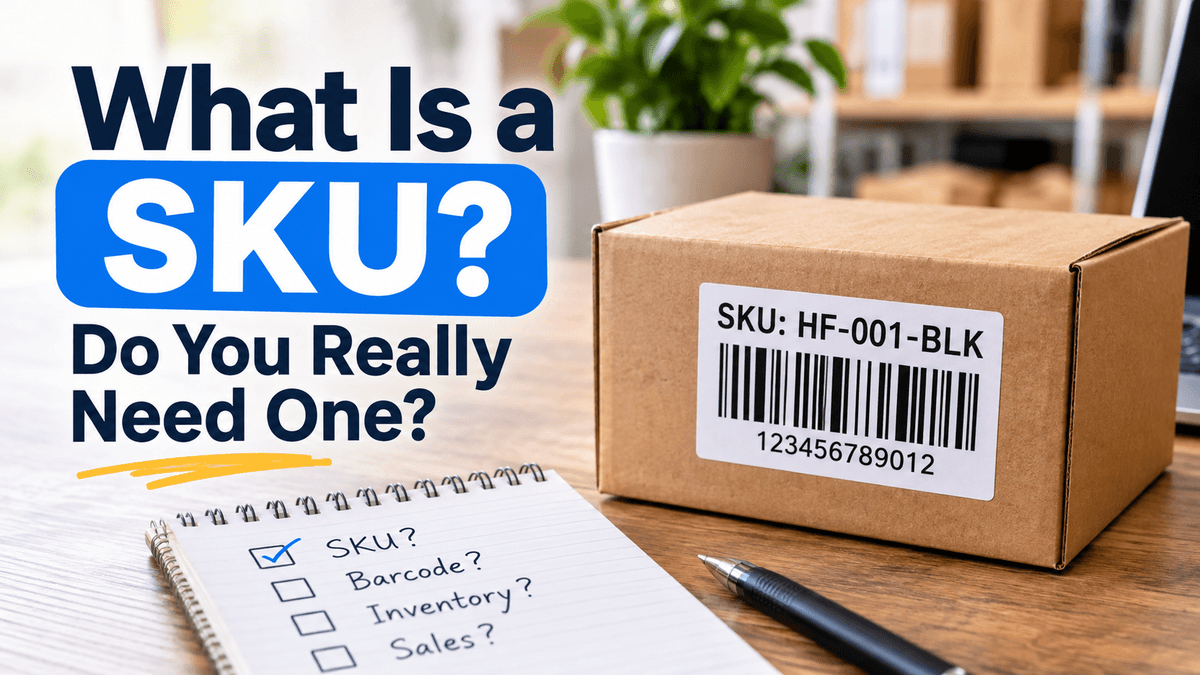
A customer messages you: “Do you still have the blue hoodie?” You have three blue hoodies. One is navy, one is “blue-ish” and one is mostly a regret. Which one are they asking about?
That’s the problem a SKU fixes.
So what is a SKU?
SKU stands for Stock Keeping Unit, which sounds fancy for what it is: a short code you give to each product. Say it like “skew” or spell it out, nobody will arrest you.
HOOD-BLU-M means hoodie, blue, medium. That’s it. One code, one exact item, no guessing.
SKU vs barcode
People mix these up all the time.
- SKU: you invent it, it’s for your own business, and no one else uses the same one.
- Barcode (UPC/EAN): a standard number that is the same in every store, made to be scanned.
You can have both on one product. The barcode is for the scanner. The SKU is for your brain.
Do you really need one?
Honestly, maybe not yet.
You can skip SKUs if you sell fewer than 20 products, none come in sizes or colors, and you remember them all without trying.
You want SKUs if:
- One product comes in several sizes or colors
- You sell in more than one place (your own shop plus Vinted, Etsy or eBay)
- Two products have almost the same name
- Someone else helps you count stock and “the blue one” isn’t specific enough
How to make a SKU in 2 minutes
- Pick a pattern: product, color, size.
- Use 3 letters for each part:
HOOD-BLU-M,CAP-BLK-OS. - Letters and numbers only. No spaces, no emojis.
- Never reuse a code, even for something you stopped selling.
The pattern matters more than the exact letters. A boring system you actually follow beats a clever one you forgot by Tuesday.
FAQ
What does SKU stand for?
Stock Keeping Unit. It’s a short, unique code you give to each product, and to each size or color of it, so you can tell items apart and track how many you have.
Is a SKU the same as a barcode?
No. A SKU is a code you make up for yourself. A barcode, like a UPC or EAN, is a standard code that looks the same in every store. A barcode can be scanned, a SKU is mostly for you.
Do I need SKUs if I only sell a few products?
Not really. With under 20 products and no sizes or colors, plain names are fine. SKUs start to matter once you sell variants, use more than one sales channel or catch yourself mixing up similar items.
How do I create a SKU?
Join 2 or 3 short parts with dashes: product, color, size. A blue medium hoodie becomes HOOD-BLU-M. Keep the pattern the same for every product, use only letters and numbers, and never reuse a code.
Still counting stock on paper? Here’s why your iPhone does it better.
If you want somewhere to put all those codes, I made Inventory & Stock Manager, an iOS app that stores a SKU and barcode for every product, tracks stock by size and works offline with no account. Download it on the App Store.